
Across Australia’s regulatory landscape, one truth is becoming impossible to ignore: the world we regulate is changing faster than the systems we use to regulate it.
Whether you are in transport, infrastructure, consumer protection, environmental compliance, or critical industries, the pattern is the same. Risks are emerging earlier. Behaviours are shifting faster. Harms are becoming more complex, interconnected, and harder to see with traditional tools.
The reality is blunt: reactive, compliance‑heavy regulation can’t keep pace with modern risk. Not when behaviours shift overnight. Not when harm emerges long before it’s visible in the data. Not when the system itself is under pressure.
This is why intelligence‑led regulation is no longer optional. It is essential.
And yet many regulators still rely on models built for a different era, models that assume yesterday’s data can predict tomorrow’s risks.
It cannot. Not anymore.
The shift we need: from reactive compliance to intelligence‑led stewardship
Modern regulation is not about counting audits or issuing notices. It is about understanding the system, anticipating pressure points, and intervening before harm occurs.
That requires intelligence, not in the “spy agency” sense, but in the regulatory sense:
- Insight into behaviours
- Foresight into emerging risks
- Context around system pressures
- Patterns that reveal where harm is forming
- Evidence that supports proportionate, defensible decisions
When regulators operate without intelligence, they are flying blind. When they operate with it, they become stewards of the system rather than administrators of rules.
Intelligence is not a team — it’s a way of working
One of the biggest misconceptions I see is the idea that “intelligence” belongs to a single unit.
It does not.
When people hear “intelligence”, they often picture a specialist team sitting in a corner producing reports. But in a regulatory environment, intelligence is far broader than that.
It is a way of working.
It is the discipline of understanding the system you are responsible for, not just what is happening, but why it is happening, what it means, and where it is heading.
It is the ability to see patterns early, understand behaviours deeply, and intervene proportionately.
A modern intelligence‑enabled regulator treats intelligence as a shared organisational discipline:
- frontline inspectors who see the early signals
- analysts who turn information into insight
- leaders who make decisions that shape the system
- policy teams who design interventions that actually work
- enforcement teams who need clarity, not guesswork
When intelligence is embedded across the organisation, it stops being a niche function and becomes a strategic advantage.
The intelligence cycle is the regulator’s superpower
Every regulator already has the raw ingredients for intelligence: data, observations, industry engagement, operational experience. What is missing is the structure.
The intelligence cycle gives us that structure:
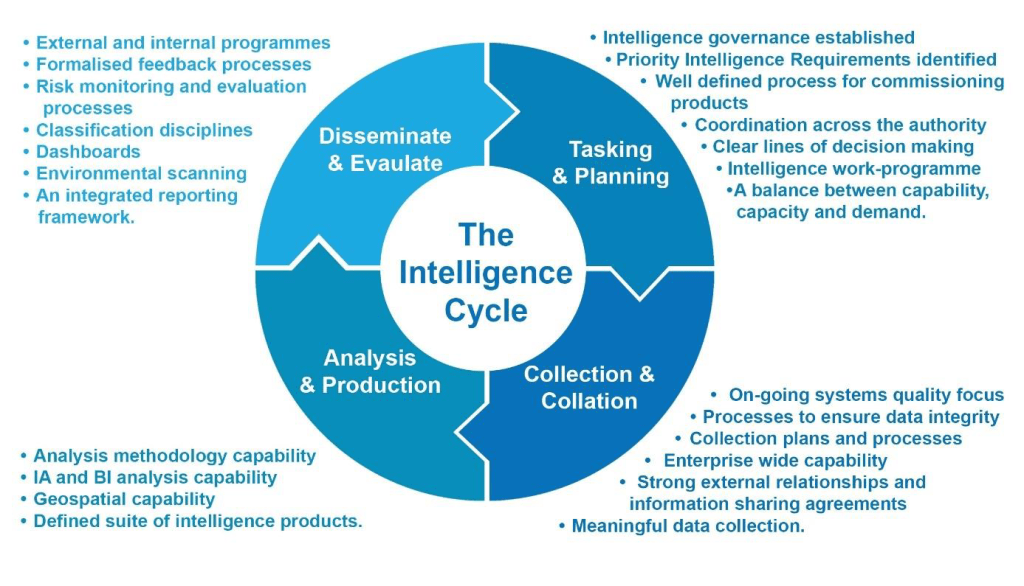
It is simple, but transformative. It turns noise into insight. It turns information into foresight. It turns reactive compliance into proactive stewardship.
Why this matters now
Australia’s regulatory environment is under more pressure than ever:
- Rapid technological change
- Increasing public scrutiny
- Cross‑jurisdictional risks
- Organised criminal infiltration
- Workforce shortages
- Complex supply chains
- Rising expectations of transparency
In this environment, regulators cannot afford to be surprised. Intelligence‑led regulation is not a “nice to have”. It is the only way to stay ahead of harm.
The regulators who thrive will be the ones who adapt
The future belongs to regulators who:
- Build intelligence capability deliberately and prioritise effort where it matters
- Invest in analytical discipline
- Strengthen cross‑agency partnerships
- Use intelligence to prioritise effort
- Shift from volume to value
- Treat intelligence as a strategic asset
- design interventions that actually change behaviour
- understand the system as a whole, not in fragments
- act early, not after harm has occurred
- make decisions that are defensible, proportionate, and evidence‑based
Those who do not will fall behind, and the system will feel it.
A final thought
Regulation is, at its core, a stewardship function. It is about protecting people, systems, and environments that matter. Intelligence strengthens that stewardship. It helps us see the system clearly, act with purpose, and intervene in ways that genuinely reduce harm. If we want to regulate with confidence, and with credibility, intelligence is not just part of the toolkit. It is the foundation to protect what matters.
 The Red Cross Ledger
Leave a comment